

Deskripsi
Balance Container
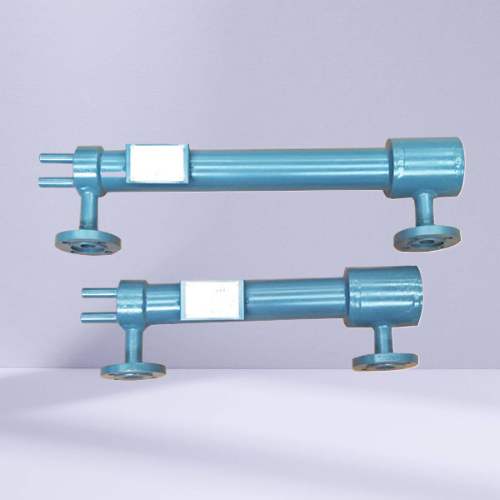
Differential pressure level gauges all use a balancing vessel , but some users are not familiar with it, especially the internal structure of a double-chamber balancing vessel , which affects its use. Here, we share some knowledge about balancing vessels . Differential pressure level gauges work based on the principle of liquid static pressure balance. The balancing vessel is actually a “level-differential pressure” converter. Its function is to create a constant liquid static pressure, compare it with the liquid static pressure formed by the measured liquid level, and output the difference between the two. The balancing vessel is essentially a condenser, and it is classified into single-chamber (single-layer) and double-chamber (double-layer) balancing vessels according to its structure. The balancing vessels used in large boilers have a more complex structure; here, we will only introduce the FP type balancing vessel commonly used in industrial boilers.
Single-chamber balance vessel:
A single-chamber balance vessel has a relatively simple structure, as shown in the figure. When measuring the liquid level in low-pressure vessels, especially when there is a large temperature difference between the inside and outside of the vessel, or when the gas phase easily condenses into liquid (such as in deoxygenated water tanks), a single-chamber balance vessel is often used. Before measurement, depending on the properties of the medium being measured, the plug of the balance vessel should be removed and filled with cold water or other liquid. In some toxic and hazardous chemical production environments, the balance vessel contains an isolation fluid.
Dual-chamber balance vessel:
The structure of the double-chamber balancing vessel is shown in the figure. A double-chamber balancing vessel is used to measure the boiler drum water level. The balancing vessel consists of two chambers, an outer chamber and an inner chamber. The outer chamber is connected to the steam in the boiler drum and is filled with condensate; the inner chamber is connected to the water in the boiler drum via a pressure pipe on the lower side of the balancing vessel. This utilizes the principle of communicating vessels, so the water level in the inner chamber changes with the water level in the boiler drum. This double-chamber structure ensures that the water temperatures in the outer and inner chambers are essentially equal, thus reducing measurement errors caused by temperature differences.
A dual-chamber balancer is used to measure boiler water level. The outer chamber of the balancer is connected to the steam in the boiler drum and is filled with condensate. When the water level in the outer chamber is lower than the pressure pipe at the top of the balancer, it is replenished by condensate from the steam in the boiler drum. When the water level is higher than the pressure pipe at the top of the balancer, water flows into the boiler drum through the pressure pipe, keeping the water level in the outer chamber constant. The inner chamber is connected to the water in the boiler drum via the pressure pipe at the bottom of the balancer, and its water level changes with the water level in the boiler drum. If the steam pressure and temperature parameters are constant, the output signal of the differential pressure transmitter is only related to the water level in the boiler drum.
For low-pressure boilers, since the density of water in the inner container is approximately equal to the density of water at saturation temperature, the water column height in the inner container of the dual-chamber balance vessel is equal to the actual water level in the steam drum. The outer chamber of the balancer is connected to the low-pressure side of the differential pressure transmitter , and the inner chamber is connected to the high-pressure side. The differential pressure generated between H and L is ΔP = Lρl – [ρ2H + (LH) × ρQ]; since ρ1 = ρ2, ΔP = Lρ1 – Hρ1 – (LH)ρQ = (LH)(ρl – ρQ), which is the conversion formula between water level and differential pressure. In other words, when measuring water level using a dual-chamber balance vessel, the working principle is to utilize the principle of hydrostatic pressure to convert the steam drum mass water level into differential pressure, which is then converted into a current signal by the differential pressure transmitter and sent to the display control instrument or DCS system.
It should be noted that, for ease of understanding, the differential pressure ΔP in the above examples refers to the height of the water column. In practical applications, it needs to be converted to Pa, which can be done by multiplying by the local gravitational acceleration g, i.e., ΔP = g[(LH) × (ρl – ρQ)]. For many medium and small industrial boilers, since the pressure of their saturated steam is not high, it is mostly treated as ρ1 = ρQ. In this case, the differential pressure is the height of the water level in the inner chamber, i.e., ΔP = ρ1Hg.


Ulasan
Belum ada ulasan.